Penile Curvature
Penile curvature is a condition that may be present from birth or develop later in life and, in some men, can interfere with sexual intercourse. Curvature associated with Peyronie’s disease may also be accompanied by pain, penile deformity, and erectile dysfunction. Today, various treatment options are available depending on the severity and underlying cause of the curvature. For more information about penile curvature and the treatment options available, please contact our clinic.
Prof. Dr. Şükrü Kumsar has extensive experience in the diagnosis and surgical treatment of Peyronie’s disease. Throughout his career, he has treated hundreds of patients, helping improve both penile function and cosmetic outcomes through individualized, evidence-based treatment approaches.
What is Penile Curvature?
Penile curvature is a condition in which the penis bends to the right, left, up or down in an abnormal manner during erection. Mild curvature may be considered normal in many men; however, significant curvature can cause difficulty during sexual intercourse, pain, aesthetic concerns and, in some cases, erectile dysfunction.
Penile curvature may be present from birth or develop later in life. The most common cause of acquired penile curvature is Peyronie’s disease. In Peyronie’s disease, a hard plaque (scar tissue) forms within the penis; this tissue prevents the penis from straightening during erection, leading to curvature.
Treatment for penile curvature is planned according to the degree of curvature, whether the condition is active or not, any accompanying erectile dysfunction, and the individual’s expectations.
At our centre, located in the Asian side of Istanbul and the Kadıköy area, we assess patients who consult us regarding penile curvature through a physical examination, photographic analysis where necessary, and an evaluation of any accompanying Peyronie’s disease or erectile dysfunction.
Degrees of Penile Curvature

Symptoms of Penile Curvature
The symptoms of penile curvature can vary from person to person. In mild cases, only a change in shape is observed, whilst in more severe cases, sexual function may be affected.
The most common symptoms:
- A noticeable curvature of the penis during erection
- A palpable hardness or plaque-like sensation in the penis
- Painful erections
- Difficulty engaging in sexual intercourse
- A sensation of shortening of the penis
- Decreased quality of erection
- Thinning of the penis or an hourglass appearance
- Anxiety regarding self-confidence and performance
What Causes Penile Curvature?
Penile curvature may result from congenital developmental differences or acquired tissue changes.
The most common cause of acquired curvature is Peyronie’s disease. In addition, in some patients, recurrent microtraumas, changes in vascular structure or connective tissue disorders may be a factor.
Conditions that may be associated with penile curvature:
- Peyronie’s disease
- Repeated microtraumas to the penis
- History of rough sexual intercourse
- Diabetes
- High blood pressure
- High cholesterol
- Smoking
- Erectile dysfunction
- Dupuytren’s contracture
Don't delay, let's meet now !
- Feneryolu Bagdat Avenue No 85/1 Postal Code: 34724 Kadıköy/İstanbul - Turkey
What Are the Types of Penile Curvature?
Penile curvature is generally classified into two main groups.
1.Congenital Penile Curvature
In congenital penile curvature, the curvature arises due to a structural abnormality that occurs during the development of penile tissues. It is usually noticed during puberty.
Characteristics:
- It is usually noticed at a young age
- It usually remains stable
- No hard plaque is present
- Treatment may not be necessary in mild cases
2.Acquired Penile Curvature (Peyronie’s Disease)
In Peyronie’s disease, a hard plaque forms within the penis. This plaque prevents a section of the penis from stretching during erection.
Characteristics:
- May occur in older age
- The curvature may worsen over time
- Pain may be present
- Erectile dysfunction may accompany it
The Difference Between Congenital Curvature and Peyronie’s Disease
| Characteristic | Congenital Curvature | Peyronie's Disease |
|---|---|---|
| Onset | Early age | Acquired |
| Pain | Usually absent | May occur |
| Hard plaque | Absent | Often present |
| Progression | Rare | May progress |
| Treatment | Mostly surgical | Varies depending on the stage |
What Causes Penile Curvature?
The cause of penile curvature may be congenital anatomical differences or acquired tissue changes. In cases of acquired curvature, the most common cause is repeated microtrauma to the penis.
Penile curvature may be associated with the following conditions:
- Rough or traumatic sexual intercourse
- Blows to the penis
- Peyronie’s disease
- Diabetes
- High blood pressure
- High cholesterol
- Smoking
- Erectile dysfunction
- Vascular diseases
- Connective tissue disorders such as Dupuytren’s contracture
Treatment for Penile Curvature
The aim of penile curvature treatment is not merely to straighten the penis; it is to reduce pain, preserve sexual function and improve the patient’s quality of life.
1.Non-surgical Treatments for Penile Curvature
a-)Watchful Waiting
If the curvature is mild, there is no pain, sexual intercourse is not affected and the curvature is not progressing, a ‘watch and wait’ approach may be recommended. It is important for the patient to be monitored regularly during this process. If the curvature worsens, pain develops, erectile dysfunction occurs or difficulties with intercourse arise, active treatment options should be considered.
b-)Medication
Medication may be preferred, particularly in the early and active stages of Peyronie’s disease. The aim is to reduce pain, limit plaque development and slow the progression of the curvature.
Medications can be taken orally, applied to the skin, or, in some patients, administered via injection into the plaque. However, not every medication is suitable for every patient. Therefore, treatment must be planned following a specialist assessment.
c-)ESWT Shockwave Therapy
ESWT is a non-surgical treatment method that involves delivering low-intensity shock waves to the penile tissue from outside the body. It is used in Peyronie’s disease, particularly to reduce pain and promote tissue healing.
ESWT may not completely correct the curvature in every patient; however, in suitable patients, it is beneficial in terms of pain management, the healing process in the plaque area, and erectile quality.
d-)Traction and Vacuum Devices
Penile traction devices aim to make the tissue more flexible over time by applying a controlled and regular stretching force to the penis. Vacuum devices, on the other hand, contribute to tissue flexibility by increasing blood flow.
These methods require regular and long-term use. As incorrect use may cause pain, bruising or tissue damage, they should not be used without medical supervision.
2.Surgical Treatments for Penile Curvature
a-)Penile Curvature Surgery
Surgical treatment is considered if penile curvature prevents sexual intercourse, if there is a significant deformity, if the curvature has stabilised, and if other treatments have proved insufficient.
Surgery is generally planned after the active phase of the condition has passed. In other words, it is expected that the pain has subsided and the curvature has not progressed for at least three months.
The main surgical methods are as follows:
b-)Nesbit Procedure
The Nesbit procedure is based on the principle of shortening the tissue on the opposite side of the curvature. It is an effective method for mild to moderate curvatures in patients who do not have erectile dysfunction and whose penis length is adequate. Its disadvantage is that it may result in a slight reduction in penis length.
c-)Plication Surgery
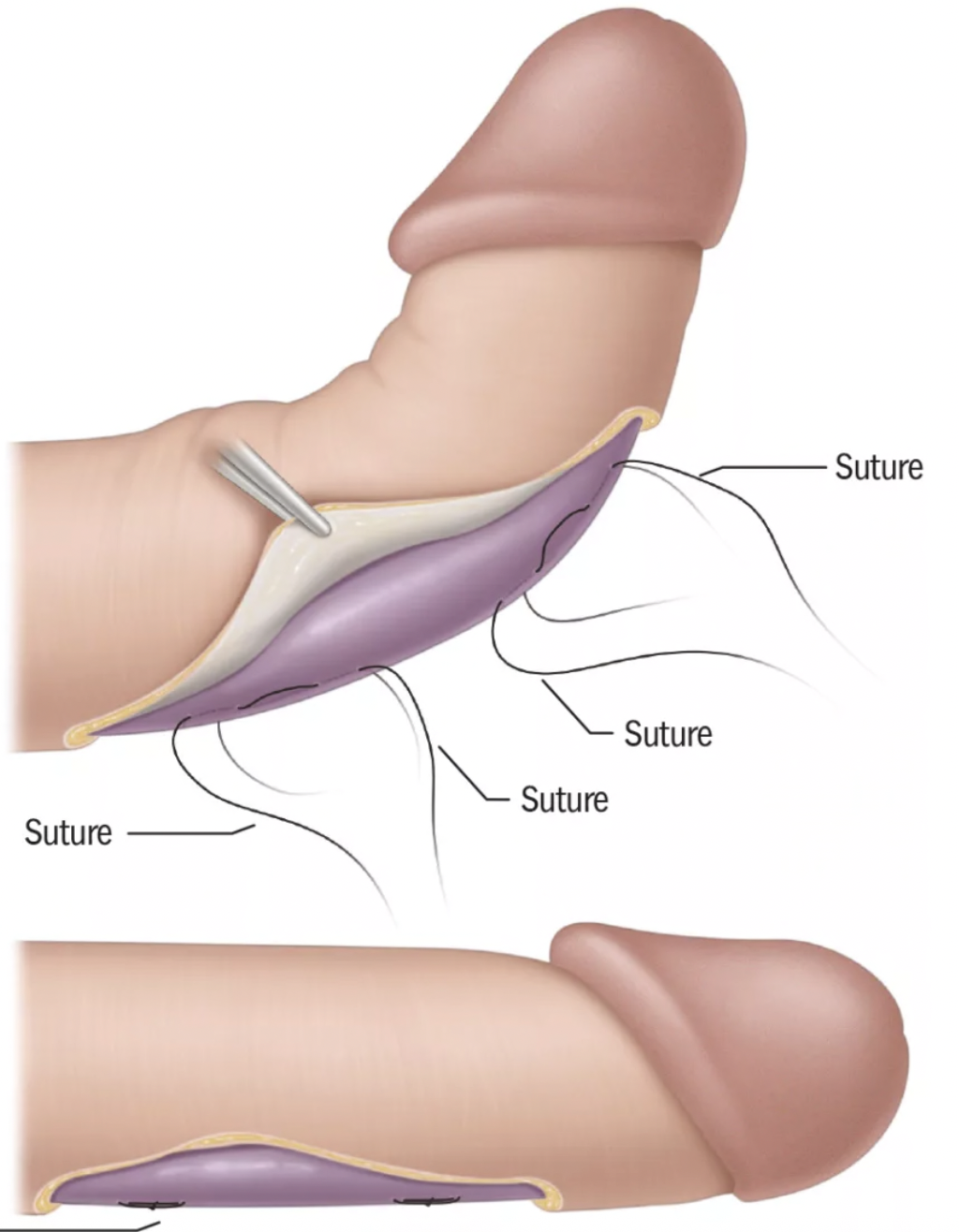
The plication method straightens the penis by placing permanent sutures on the opposite side of the curvature. It yields results similar to the Nesbit method. It is a simpler technique, but there may still be a slight shortening of the penis.
d-)Plac Excision and Grafting
In cases of severe curvature, complex deformities, or where there is a significant loss of penile length, the plate may be cut or removed and replaced with a graft. This method requires more advanced surgical expertise. It can be effective in restoring penile straightness in suitable patients.
e-)Penile Prosthesis
If penile curvature is accompanied by erectile dysfunction, penile prosthesis treatment may be considered. A penile prosthesis can help to resolve erectile dysfunction as well as correct the curvature. It is a particularly important option in cases of advanced Peyronie’s disease combined with erectile dysfunction.
Comparison of Penile Curvature Treatments by Disease Type
| Treatment | Congenital Penile Curvature | Peyronie's Disease (Acquired) |
|---|---|---|
| Watchful Waiting | May be appropriate for mild cases that do not interfere with sexual intercourse. | May be considered during the active phase to monitor progression and pain. |
| Medication | Generally has a limited role. | May be considered, particularly during the early/active phase. |
| ESWT (Extracorporeal Shock Wave Therapy) | Not routinely recommended. | May be used in selected patients for pain relief and as an adjunctive treatment. |
| Penile Traction / Vacuum Devices | May be beneficial in selected patients. | May be considered in selected patients during the early to intermediate stage. |
| Surgery (Plication / Nesbit Procedure) | One of the most commonly preferred definitive treatment options. | May be performed in suitable patients during the stable phase. |
| Plaque Excision with Grafting | Generally not preferred. | May be considered for severe curvature and complex deformities. |
| Penile Prosthesis | Rarely required. | May be considered in patients with concomitant erectile dysfunction. |
Post-operative Recovery Process
Following penile curvature surgery, patients are usually discharged on the same day or the following day. Pain, swelling and bruising may be observed in the penis during the first few days. During this period, it is important to take antibiotics and painkillers and to have the dressing checked.
Sexual intercourse is generally permitted after 4–6 weeks. Once the healing process is complete, the penis becomes straighter and more functional in the majority of patients. Patient satisfaction rates are very high when patients are selected appropriately and the correct surgical technique is used.
Risks of Penile Curvature Surgery
As with any surgical procedure, there may be some risks associated with penile curvature surgery:
- Pain
- Swelling and bruising
- Infection
- Changes in sensation
- Shortening of the penis
- Partial persistence of curvature
- Change in erection quality
For this reason, the patient’s expectations, penis length, degree of curvature and erectile function must be assessed in detail prior to the decision to operate.
Living with Penile Curvature
Penile curvature is not merely a physical problem. In many men, it can lead to a loss of self-confidence, anxiety about sexual performance, difficulties in relationships with partners, and psychological stress.
It is important to know that this condition is treatable. It is essential to consult a urology or andrology specialist, particularly in cases where the curvature makes sexual intercourse difficult, causes pain, or worsens over time.