How Safe Are Herbal Sexual Enhancers?
20 October 2025
Selective Dorsal Neurectomy (SDN)
6 November 2025Cryoablation (Nerve Freezing) Treatment for Premature Ejaculation
Premature ejaculation is the inability to control ejaculation during sexual intercourse, resulting in ejaculation occurring too quickly. The International Society for Sexual Medicine (ISSM) defines this condition into two main groups:
1. Lifelong (primary) premature ejaculation: This occurs when ejaculation happens within 1 minute of vaginal penetration in every sexual encounter since the onset of sexual activity.
2. Acquired premature ejaculation: This occurs in a man who was previously able to ejaculate within a normal timeframe, but over time, the ejaculation time has shortened to less than 3 minutes.
The common factor in both cases is that the man is unable to control ejaculation despite wanting to, and this causes significant distress (stress, discomfort, loss of self-confidence) in both him and his partner.
One of the goals in the treatment of premature ejaculation is to balance the neural stimulation that makes the ejaculation reflex overly sensitive. In some patients who do not respond adequately to medication, behavioural therapy, or local applications, interventional methods aimed at reducing the excessive sensitivity of the nerves come into play. At this point, cryoablation, or "nerve freezing," emerges as a modern option.
What is Cryoablation?
Cryoablation is a treatment method that minimises damage to surrounding tissue by controlled freezing of targeted tissue or nerves to halt their function. "Cryo" means cold in Greek, while "ablation" means removal. By briefly lowering the tissue temperature to between –40 °C and –70 °C, intracellular ice crystals form, which temporarily or permanently block nerve conduction.
This technique is used in the treatment of various diseases in cardiology, oncology and urology. In urology, it is particularly used in prostate and kidney tumours, as well as in the treatment of premature ejaculation caused by dorsal nerves, as "nerve freezing" or selective dorsal cryoablation.


What is Selective Penile Dorsal Nerve Cryoablation?
The dorsal penile nerves are nerve fibres that branch off from the pudendal nerve and pass through the upper and root parts of the penis, enabling the transmission of sensory stimuli to the penis. While the surgical cutting of these nerves has long been a method used in patients with resistant premature ejaculation, the selective freezing of these nerves via cryoablation is a more modern and minimally invasive treatment option.
.
How is Nerve Freezing (Selective Dorsal Cryoablation) Performed?
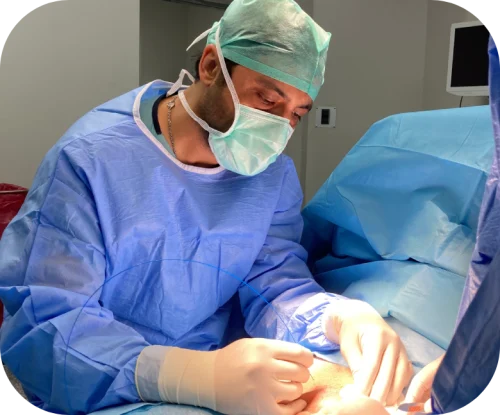
The procedure is performed under local anaesthesia, while the patient is awake, and is painless.
- Target Identification: The dorsal nerve branches responsible for excessive sensitivity at the head of the penis are identified using ultrasound or nerve stimulation.
- Cryoprobe Application: These nerve areas are briefly cooled to -60°C using a thin cryoprobe (a needle with a cooling tip).
- Freeze-Thaw Cycle: Intracellular ice crystals interrupt nerve conduction; the tissue then thaws slowly.
- Total Duration: This takes an average of 20–30 minutes, and patients are usually discharged on the same day.
Although it has a similar effect to classic surgical nerve sectioning (selective dorsal neurectomy, SDN), the advantage of cryoablation is that it does not require incisions and preserves nerve integrity, reducing the risk of sensory loss.
Applications of Cryoablation in Urology
- Prostate and kidney tumours: Targeted destruction of cancerous tissue
- Pudendal nerve block: Reduction of pelvic pain
- In the treatment of premature ejaculation: Temporary deactivation of hypersensitive nerve endings in the head and shaft of the penis
In recent years, it has been applied to selected patients, particularly in cases of resistant premature ejaculation.
Scientific Evidence: Systematic Review Findings
A systematic review and meta-analysis published in The Journal of Sexual Medicine in 2025 examined 7 clinical studies (total of 235 patients).
Key Findings
- Significant increase in ejaculation latency time (IELT):
An average increase of 147.5 seconds (approximately 2.5 minutes) was observed.
This corresponds to approximately a threefold improvement compared to pre-treatment levels. - Patient and partner satisfaction has increased significantly:
The Sexual Satisfaction Score (SSS) has increased from 1.3 to 4.6 (p < 0.001).
The Premature Ejaculation Diagnostic Tool (PEDT) score decreased from an average of 14.8 to 5.0. - Erectile function has been preserved:
No significant changes were observed in IIEF-5 scores. - The complication rate is low:
No serious permanent loss of sensation or erectile dysfunction has been reported.
Most studies had follow-up periods of 6–12 months and reported that both neuroectomy (SDN) and cryoablation (CA) methods were similarly effective and safe.
Comparison with Other Treatment Methods
| Treatment Method | Mode of Application | Duration of Effect | Advantage | Disadvantage |
|---|---|---|---|---|
| Behavioral Therapy | Exercise / training | Variable | Drug-free | Time-consuming |
| Dapoxetine (SSRI) | Oral medication | 4–6 hours | Rapid effect | Nausea, temporary effect |
| Topical Lidocaine / Prilocaine | Spray / cream | 30–60 min | Easy to apply | May cause numbness |
| Glans Filler (Hyaluronic Acid) | Hyaluronic acid injection | 12–18 months | Aesthetic + improved control | May require repetition |
| Cryoablation (Nerve Freezing) | Dorsal nerve cooling | 1–2 years | Permanent, drug-free, natural sensation preserved | High cost, requires expertise |
Other Treatment Methods for Premature Ejaculation


Advantages
- ✅ Does not require incisions, is suture-free.
- ✅ Does not completely eliminate natural sensation, only reduces excessive sensitivity.
- ✅ Painless and quick; patients are discharged on the same day after the procedure.
- ✅ Ideal for patients who do not wish to take medication or who experience side effects.
Risks and Possible Complications
Short-term bruising, swelling, or mild numbness may occur.
According to a meta-analysis, the rate of serious permanent complications is <5%, and erectile function is preserved.
Who is it suitable for?
- Patients who do not respond to topical or systemic treatments
- Cases with excessive glans sensitivity
- Men seeking a drug-free, permanent solution that does not require surgical incisions
Cryoablation Prices (2025 Turkey Data)
The cost varies depending on the device used, the hospital's infrastructure, and additional procedures. In some centres, it can be performed under local anaesthesia and in a single session.
Please don’t hesitate to contact us for any inquiries:
Conclusion
Cryoablation (nerve freezing) and selective dorsal neurectomy are modern approaches focused on neuromodulation of penile sensitivity in the treatment of premature ejaculation.
Studies have shown that these methods extend ejaculation time by an average of three times, preserve erectile function, and significantly increase satisfaction rates.
Although long-term results are needed, current evidence confirms that cryoablation is an effective, safe, and minimally invasive option for patients with drug-resistant premature ejaculation.