What Is Urology? Which Diseases Does Urology Treat?
22 December 2025
Circumcision: Medical and Scientific Perspectives
4 January 2026Penile Prosthesis (Happiness Stick) Surgery in Kadıköy, Istanbul
Searches such as penile prosthesis Istanbul Anatolian Side and penile prosthesis Kadıköy Istanbul have increased significantly in recent years. The main reason for this is the growing awareness of erectile dysfunction (ED) and the better understanding of permanent surgical treatment options. Penile prosthesis surgery, commonly known as the “happiness stick,” is one of the most effective and permanent solutions for patients who do not benefit from medications, injections, or other treatment methods. With this procedure, patients can achieve a controlled and sufficient erection whenever desired, significantly improving their sexual quality of life. In this article, you will find comprehensive and evidence-based answers to frequently asked questions such as what penile prosthesis surgery is, who it is suitable for, how it works, types of implants, the surgical process, and how penile prosthesis surgery is planned in Kadıköy, Istanbul.
When performed by experienced urologists, penile prosthesis surgery is a safe, fast procedure with a high success rate. It usually takes 45–60 minutes, and patients are most often discharged on the same day or the following day.
Preoperative Preparation
Before penile prosthesis surgery, patients undergo a specific preparation process.
Preoperative requirements include:
- Detailed urological examination
- Blood tests and anesthesia evaluation
- Urinalysis and, if necessary, urine culture
- Adjustment of blood-thinning medications
- Blood glucose control in diabetic patients
- Selection of the prosthesis model (inflatable / malleable)
- Patient information about the surgery and postoperative period
What Is Done During the Surgery?
Inflatable Penile Prosthesis
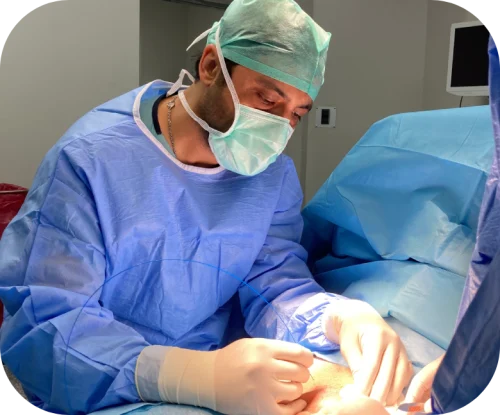
The surgery is usually performed under spinal or general anesthesia. The patient does not feel pain during the procedure. Surgery begins with a small incision of approximately 3–4 cm between the base of the penis and the scrotum. After healing, this incision leaves little to no noticeable scar in most patients.
Following the incision, access is gained to the spongy erectile tissues inside the penis, known as the corpus cavernosum channels. These channels are carefully prepared using special surgical instruments, and the most appropriate prosthesis size is determined. The inflatable prosthesis cylinders are then placed inside the penis.
In the next step, the fluid reservoir that allows the prosthesis to inflate is placed in the lower abdominal area or behind the groin muscles. Subsequently, the pump that controls the prosthesis is placed inside the scrotum in a way that does not disturb the natural appearance.
After confirming that all components are functioning properly, the incision is closed with internal and external sutures, and dressing is applied. Inflatable penile prosthesis surgery takes approximately 45–60 minutes.
Malleable Penile Prosthesis
Malleable penile prosthesis surgery is also performed under spinal or general anesthesia. The procedure typically begins with a small incision between the base of the penis and the scrotum, which usually does not leave a permanent scar.
The corpus cavernosum channels inside the penis are prepared using special dilators. After determining the appropriate prosthesis length according to the patient’s penile measurements, the malleable prosthesis rods are placed into these channels. This type of prosthesis does not include a reservoir or pump.
After verifying symmetrical and functional placement of the prostheses, the surgical area is closed, sutures are applied, and dressing is performed. Due to fewer procedural steps, malleable penile prosthesis surgery is generally completed within 30–45 minutes.
Postoperative Period
After penile prosthesis surgery, patients usually recover very quickly. Mild pain and swelling may be observed immediately after surgery; this is normal and can be controlled with prescribed painkillers and antibiotics. Most patients are discharged on the same day or the following day.
During the first week, daily activities are allowed, but heavy lifting and intense sports are not recommended. Swelling in the penile and scrotal area during this period is normal. By the third and fourth weeks, swelling and sensitivity decrease significantly. Patients with inflatable prostheses are taught how to use the device during this period. Between the fourth and sixth weeks, the prosthesis becomes fully functional, and patients are allowed to resume sexual intercourse.
Today, penile prosthesis surgeries have success and satisfaction rates exceeding 95% and are among the most effective surgical treatments for erectile dysfunction.
Pre- and Post-Operative Considerations
What should be considered before and after penile prosthesis surgery?
Don't delay, let's meet now !
- Feneryolu Bagdat Avenue No 85/1 Postal Code: 34724 Kadıköy/İstanbul - Turkey
How Is Penile Prosthesis Use Taught?
Approximately three to four weeks after surgery, the patient is called for a follow-up visit, during which prosthesis use is taught in detail. In inflatable prostheses, the location of the pump and the inflation and deflation mechanisms are demonstrated practically. In some patients, short-term daily pumping exercises may be recommended to facilitate easier use of the prosthesis.
Patients with malleable prostheses are instructed on positioning the prosthesis for intercourse, comfort during daily use, and clothing compatibility. Both prosthesis types are not noticeable from the outside and do not affect daily life.
Is Penile Prosthesis Surgery Safe?
Penile prostheses produced with current technology have special infection-preventive coatings. When performed in experienced centers, the infection risk ranges between 1–3%, which is quite low. Therefore, penile prosthesis surgery is considered a reliable surgical method.
Advantages of Penile Prosthesis Surgery
Penile prosthesis surgery offers a permanent solution for erectile dysfunction. It provides a natural and strong erection and completely eliminates the need for medications or injections. It does not affect daily life, is not noticeable from the outside, and patient and partner satisfaction rates are extremely high. Since erection is fully controllable, self-confidence in sexual life increases significantly.
Life After Penile Prosthesis Surgery
After surgery, patients can comfortably continue their normal daily lives. The prosthesis does not restrict activities such as walking, sports, swimming, or traveling. It does not cause problems during air travel or medical imaging such as MRI; most modern prostheses are MRI-compatible. Sexual quality of life improves, and the prosthesis is not noticed by the partner.
What Is the Lifespan of a Penile Prosthesis?
Modern penile prostheses are highly durable due to advanced manufacturing technologies. The majority can be used without problems for an average of 15–20 years. Prosthesis lifespan depends on factors such as the selected model, proper use by the patient, presence of comorbidities, and surgeon experience. In new-generation prostheses with antibacterial coatings, mechanical failure rates are around 1–3%, and infection risk is very low.
Penile Prosthesis User Reviews (Patient Experiences)
Scientific publications report patient satisfaction rates of 85–95% after penile prosthesis surgery. The most frequently emphasized point in user reviews is the significant increase in self-confidence following the restoration of sexual life. Most patients use expressions such as “my life has changed” or “I wish I had done this earlier” after surgery.
Making sexual performance reliable and controllable has not only physical but also psychological benefits. Clinical observations show that partner satisfaction is also very high, the prosthesis is generally not noticed by partners, and relationship quality improves. Many patients also report that the recovery process was easier than expected and that they were able to return to daily life within one to two weeks.
Penile Prosthesis Surgery Costs
Penile prosthesis surgery costs vary depending on the type of prosthesis used, brand and model, hospital conditions, and the experience of the surgical team. The most important factors affecting pricing include whether the prosthesis is malleable or inflatable, the preferred brand (such as Boston Scientific or Coloplast), length of hospital stay, and the scope of the surgery.
While malleable penile prostheses generally offer more economical options, three-piece inflatable prostheses are more costly due to their advanced mechanism and comfort. However, the most appropriate option for each patient should be determined after a detailed examination and evaluation of expectations. Definitive pricing requires patient-specific planning, and therefore cost information is usually clarified after consultation.
.
Risks and Complications of Penile Prosthesis Surgery
Penile prosthesis surgery is a safe surgical method when performed in experienced centers. However, as with any surgical procedure, some risks exist. Possible complications include infection, mechanical failure, temporary pain and swelling, bleeding, and rarely, prosthesis displacement.
With modern prostheses manufactured using current technology and antibacterial coatings, the risk of infection and mechanical problems is quite low. When applied with proper patient selection by an experienced surgeon, these risks remain minimal.